The nation's political direction has become a concern for many Ukrainians.
The message many are receiving now is very different from the one of hope and pledges of reform they put their faith in at last years elections.
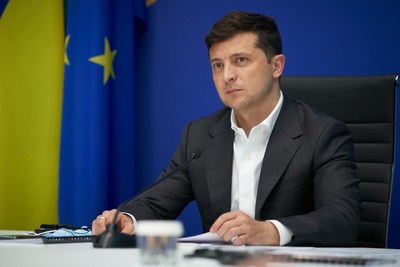
In recent months, Ukrainian president, Volodymyr Zelenskyy, who was elected in 2019 on the promise of wide-reaching reforms to battle corruption and improve the economy, has sacked and replaced the government for being inept.
Former prime minister, Oleksiy Honcharuk, was fired in March, along with several of his ministers, the Ukrainian prosecutor general, Ruslan Riaboshapka, and other officials. Honcharuk and Riaboshapka, who were well-regarded in the West, have since expressed their concern about the direction of Ukraine, where they feel the malign influence of powerful people on the countrys economy is growing.
Since early March, when Zelenskyy changed the government for no apparent reason with unknown people, there has been no direction in the government, Anders slund, an economist and senior fellow at the Atlantic Council, told Euronews.
We have seen that Zelenskyys new people have undone everything that was done before. It seems for me that it is done to restore corruption and oligarchs seem to influence this development.
Everything is getting destroyed.
The hope for a better future which prevailed when Zelenskyy was elected has gone, he adds. slund is not the only one who is sceptical about what is going on inside Ukraine, where the government, he says, is turning away from anti-corruption measures and western-style reforms.
The International Monetary Fund (IMF) recently provided Ukraine with a $5 billion (4.4 billion) loan to battle COVID-19, but noted in a report that reforms increasingly faced resistance from vested interests, and court rulings were undermining reform progress, especially in tackling corruption and financial sector reforms.
At the beginning of July, the governor of the National Bank of Ukraine, Yakiv Smolii, handed in his resignation because of systematic political pressure, which, he said, makes it impossible for me, as chairman, to effectively manage the National Bank. Some experts see the dismissal as yet another example of the deteriorating situation in Ukraine, where they fear that the independence of the Ukrainian National Bank is under pressure, which could jeopardise the countrys IMF loan.
Aleksey Jakubin, who is an associate professor at Kyiv Polytechnic Institute and an expert in Ukrainian politics, told Euronews that it is all too easy to claim that the time for reforms in is over; in part because reforms take a long time, but also because the previous government under Honcharuk was incompetent. The Presidents party Servant of the People had a majority in parliament, so therefore Honcharuk had every opportunity to push reforms over the line during his tenure, says Jakubin.
But the reforms of the government of Honcharuk had no visible effects, and it seems that they were not ready to understand the situation in the economy, says Jakubin, I think that the new government led by prime minister Denys Shmyhal is much more realistic than Honcharuk, who acted under his own personal economic, social and political visions, maybe neo-liberal, while Shmyhal is much more technical and looks at the Ukrainian situation.
Jakubin is, however, worried that Ukraine is unable to shake off its toxicity, making it more difficult for the country to reform itself while also putting more pressure on reformers who want to implement change.
People with business interests in Ukraine are also becoming increasingly worried. In an email to the Kyiv Post, Tomas Fiala, the CEO of Dragon Capital, wrote that: We will put new investments on hold as the authorities have been doing for the last five months exactly the opposite from what investors, both domestic and international, expect from them and advise them. This is the last straw.
Pavlo Kutuev, the chair of the sociology department at the Igor Sikorsky Kyiv Polytechnic Institute, says that Western experts and investors may have put too many expectations for Zelenskyy and that we are seeing now is simply a return to how things are normally done in Ukraine.
It is an exaggeration to say that the time for reforms is over. I have never been too optimistic about the ambitions and hopes for modernisation and reforms in Ukraine, says Kutuev. We can say that the neo-liberal ideas, seen under Honcharuk, and Western hopes for rapid reforms in Ukraine are partly over, because we have seen, in my view, a return to reality in Ukrainian politics.
Kutuev says that Ukraine is a complex country with a lot of social and economic problems that need to be dealt with. The country is still scarred by its Soviet past, too. To paraphrase the title of Lenins 1904 book, reforms in Ukraine, he says, are often is one step forward and two steps back.
Tymofiy Mylovanov, on the other hand, who was the former economy minister before the presidents cabinet reshuffle back in March, is definitely someone who sees the window of opportunity to reform Ukraine waning.
Mylovanov decided to resign after Honcharuk was dismissed as prime minister as he did not agree with the views of the new team brought in by the president. While Zelenskyy was effective in disrupting the political system, it is unclear what the strategy is now, he contends.
I see the typical rhetoric now. That we need to support the Ukrainian economy, need to increase pension, need to trade more. Still, it is standard things to hear from politicians all over the world, says Mylovanov, who now is the head of the Kyiv School of Economics. This is standard politics, but I do not see a clear and consistent approach now and, therefore, the window for change appears to be limited.
Shortly after the government reshuffle, officials appointed to fight corruption pervasive in the economy - often the most corrupt sector - were also removed. Among them was Maxim Nefyodov, who was the head of the State Customs Service. He had been set the ambitious goal of cutting corrupt customs practices in half over 18 months but found himself out of a job after less than a year.
The time for reforms in Ukraine is over, he told Euronews. The signal that the government is now sending to people is this: being a reformer means that you will be harassed, get bad PR and that you will have no political future.
While being a bad guy, who is not reforming the system, means that you will be fine and have no problems. It is the signal the government is sending because the patience and willingness in the political system are gone, and the bad guys just need to wait us out.
Immediately after taking office, he said he was followed in the streets and attacked in the media by opponents because he tried to change the corrupt system which benefitted smugglers and some oligarchs who were not happy and wanted to fight back. He expected this but hoped for better support from the president, which diminished quickly.
The official explanation for Nefyodovs dismissal was that he was ineffective in his role and that he did not deliver the promised results. While Nefyodov argues that he could have done more, reforms take time, he says, adding that he couldnt solve customs corruption in a matter of months when several thousands of cars and trucks need to be checked every day.
After his dismissal, the National Anti-Corruption Bureau of Ukraine (NABU) started investigating Nefyodov for corruption, which some Western experts such as slund see as merely a political move. The NABU case is now closed, Nefyodov said.
Zelenskyy brought in a young - and mostly politically inexperienced - team last year when he first won the presidency and later a majority in parliament. The new government was a great source of hope among Ukrainians; partly because it had a majority, but also because it brought with it new faces and tall ambitions. However, in the last few months, the presidents approval rate has plummeted to 38 per cent from being higher than 50 per cent right after his election. While many experts and former politicians are raising concerns, not all experts agree.
Responding to claims made by Mylovanov and Nefyodov, chairman of the Penta Center of Applied Political Studies, Volodymyr Fesenko believes that they should have known that the political environment in Ukraine is tough and competitive, and that they were real concerns about their suitability.
The main reasons for the dismissal of those who complained to you are that they were weak reformers and even weaker politicians, who did not know how to build communication with other political actors and did not know how to work with public opinion, he said.
They did not have a strategy and tactics for reform. In Ukraine, reforms that are carried out by political coalitions and only reform teams are successful. Single reformers tend to lose.
Fesenko agrees that it is difficult to change things when governments are often dismissed, but he does not believe the window for reforms is closing in Ukraine. He still sees reform-friendly ministers in government and agrees that Zelenskyy wanted people with more experience.
We must also consider the psychology of President Zelenskyy, who does not want to wait long for results and expects quick and effective results from his ministers. Ukrainian voters do not want to wait either, Fesenko says, pointing out that Ukraine has seen several reforms approved, such as land reforms which enable the sale of agricultural land, and a new banking law."
However, slund contends that those reforms were carried out only because the IMF was twisting Ukraines arm and leveraging its multi-billion dollar loan to combat the economic effects of COVID-19.
Mylovanov and Nefyodov deny being inefficient but instead argue that the real problem is the lack of political stability and the attacks from the opposition and oligarch-controlled media.
Sergii Verlanov, who was the head of the Ukrainian State Tax Service and was also fired after a few months in office, says that Zelenskyys government could have done better - and that the current developments in the country are worrying.
In 2019, we met the revenue target in the State Tax Service for the first time in many years, and I was, therefore, not dismissed because I was underperforming, he says. I dont know why I was sacked, but the government sends a signal to everyone that it is going for the quick wins rather than the lengthy reforms. It might be better for your approval ratings now, but it does not give success in the long run and will not change the system.
Verlanov says that while he must give credit to the Ukrainian parliament for passing more than 60 laws, some of which could bring about real change, many of them never got implemented. Like Nefyodov, Verlanov is also being probed after his dismissal. According to Ukrainian media, the SBU, Ukraines Secret Service, has opened an investigation claiming that he is laundering funds to finance terrorism, an accusation which Verlanov says is ridiculous and common practice to discredit people being removed from office.
According to Mylovanov, Ukraine may need to learn that it cannot change its government all the time, in the same way, a young person would need to learn realities the hard way. He notes that Ukraine has had 18 different prime ministers since it gained its independence from the Soviet Union 29 years ago.
I also fear that the current prime minister, Denys Smygal, will not last long, he adds. Ukraine needs to stick with people long [enough] for things to change, but it seems like the only people fighting for the government in Ukraine is the prime minister and the president. Everyone else wants to dismantle the system for personal gains or other reasons. It is a toxic environment.
Euronews contacted Yulia Mendel, the press officer for President Zelenskyy, for comment. She has not responded.
Go here to read the rest:
Corruption in Ukraine: Is time running out for Zelenskyy to reform the country? - Euronews